By David Yeager
0. Intro
Status & Respect
Young person’s priorities (Adolescent Predicament)
- Sense of status = highlight their competence and expertise
- Avoid I know better
- Presume agency: assume young person can make up their own mind and make it clear you’re rooting for them to make the healthy choice
- Point out broader implications of their decision (how it helps others)
- Social credit
- Sense of status = highlight their competence and expertise
Testosterone makes more sensitive to respect & status
I. Mentor Mindset: Lewin’s Leadership Styles
- Always had plenty to do
- Expected students to work hard & accomplish a lot, while providing material & emotional support
- Guide students to complete project using socratic questioning— didn’t tell them how to complete project
- Didn’t praise them if work wasn’t adequate
- Gives young people a route to status and respect
- Support still enables caring for them
Adolescent predicament <> Mentor style {gave prestige to/empower/let earn status}
whakamana
1. (verb) (-a,-hia,-ia,-ngia,-tia) to give authority to, give effect to, give prestige to, confirm, enable, authorise, legitimise, empower, validate, enact, grant.
2. (noun) ratification, endorsement, confirmation, authorization, warrant.
—> Give ppl opportunity to obtain **what counts for status in a given social group**

—> *Prestige*: comes from *reputation* of being valuable to the group
Enforcer: high standards low support
- Obnoxious aggression
Protector: low standards high support
“Ruinous empathy”
Students/employees yearn for structure & attention & to be pushed
Nice & friendly, cool with anything
- Prioritizes self esteem boosts rather than legitimate accomplishment
- Psychology: comes from place of caring for the person over performance
- But it doesn’t push them to grow & can even come across disrespectfully — views them as incompetent
- Prioritizes self esteem boosts rather than legitimate accomplishment
—> Both deny the opportunity to earn prestige.
—> Both come from the belief of neurobiological incompetence
- Must believe “young people are ready to learn and grow”
    - **Core Beliefs**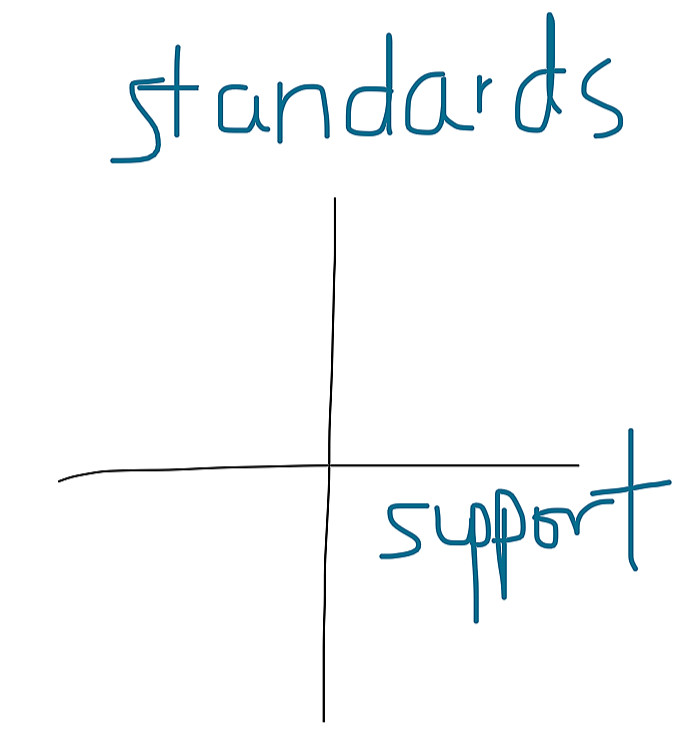
III. Ch 3 Generational Divide
- Young ppl reject old ppl advice bc they interpret it as looking down on them/implying their incompetence
V. Ch 5 Transparency
“Collaborative Troubleshooting”
* LET’S figure it out (together, not just left to fend alone)
* + Troubleshoot= it’s not a black or white you’re dumb/smart, it’s *let’s tinker w/ this*
    *No all or nothing thinking/labels*
Transparency = in a potential threat situation (e.g. feedback, proactive policing of community…)
“You might be the only one courageous enough to ask the question”
- Make questions high status (give affirmation when asked)
VI. Ch 6 Questioning (Lorena’s Parenting Principle)
“Can you help me understand what you really needed in that moment;
So that I can help you get it next time?”
“Could it be anything else?”
Kids get mad over what something meant, rather than what happened
- Injustice
- Detect hypocrisy
“Now that I understand what you needed, what could I have done to make sure you got it?”
- Child feels heard, but also has to think
“What can I say to you next time, so that we quickly figure out what you need, rather than having a fight?”
- Could you tell me what you’d like to hear from me?
- Cut straight to problem solving, no I hate you’s
- No paternalistic approach, “cut it out”
“Are we fighting over what we really need, & can we find a way for both of us to get what we need, and that in our house we’re supposed to solve our own problems respectfully because you want us to become successful adults when we grow up and move out.”
Best manager: Jen Wu from Reach CapitalSilicon Valley edtech VC
Yeager was 25 y/o PhD, inefficient and unrealistic
Jen met w/ him 15 min every morning to help him prioritize
- Jen: David, what are you planning on working today?
- David: [states unrealistic 3 week LOE work]
- Jen: ok, which part is most important to do now?
- David: something else…
- Jen: Ok, if you do that thing, do you have the resources needed to do it?
- David: No
- Jen: if I got you resources & you worked on 1st step towards bigger project, how much could you get done today?
- David: now can lay out organized plan linked to what he needs for it
- Jen: try that and come check with me
Her challenging q’s made it feel she took him seriously & thought he had it in him to make a strong plan.
Kept asking until she fully understood
Power of Questions
Questions can befuddle, or give agency & form basis of relationships
Plato’s Meno— Socrates & know it all Meno
Virtue
Socrates used Qs to reveal Meno’s ignorance
Questions can be used to reveal knowledge we didn’t know we had
Dialogue format, questions lead to deeper knowledge
✨Authentic Questions w/ Uptake
- Q’s you truly don’t know the answer to
- Ask them to explain their thinking
- W/ uptake: asker incorporates info from answerer— tailors q to the discussion/answerer’s needs
- Teens constantly trying to make sense of how they’re being treated.
- Does the questioner want ammo to work against me, or work together as equals?
- Benefits to cognition: authentic q’s make teens think harder/deeply, demands original thinking from them
- Great negotiators ask great q’s
- ++Mirroring++: repeat the last ~3 words, turn into a question
- Pure form of authentic / uptake
- Repeat the subject’s words back to them
- It prompts them to expand on their thoughts
- Expert tutors: make them think “does this work?” “Does that seem right?”
- Humble inquiry, true desire to understand person/needs
Q Sets!
==What does this [what just happened] mean to you?==
==How does that [meaning] make you feel?==
==Is that serving your goals/making you happy?==
Reframe:
What else could it could mean?
How would it make you feel if you thought that?
Would that serve your goals/make you happy?
VII. Ch 7 Stress
- Culture thinks stress is debilitating, but it should be energizing
- Protector mindset: you’re too stressed, incomplete work
- Enforcer: suck it up
- Mentor: give flexibility in logistics but maintain intellectual rigor standards
- Kid going through struggle— having a purpose at work can help anchor in midst of grief
- Stressor vs Stress Response:
- Stressor: presentation, incoming car
- Neither good nor bad
- Stress response
- Can be + or -
- Focus on the excitement to show what you’ve accomplished
- Stressor: presentation, incoming car
== do not need to remove the stressor and go into protector mindset. The stress response.
- Appraisals of demand/severity of effort, resources available (skills, preparation, time, help)
- Subjective perceptions of demand level AND resources (comfy reaching out for help to peers?) differ.
Appraisals are key to good/bad stress response
- ==Threat type response== (demand of stressor> resources to cope)— prepare body/mind for damage/defeat. Vascular constriction, minimize blood loss, release cortisol (reduce inflammation in damaged tissue), reduce testosterone (caused by defeat)
- People underperform bc brain cells receive less oxygenated blood
“Not enough resources”
- ==Challenge type stress response==— sufficient resources to meet high demands of stressful situations
- Heart pumps more blood to body
- Doesn’t produce as much cortisol (doesn’t expect defeat)
- Produces more testosterone (expects prestige from success)
“Physiological stress responses are normal & assets” (Jameson study)- Measured by constriction or dilation of blood vessels!
△ appraisal -> △ response.
*Change your threat type response. *
Synergistic mindsets intervention:
Danielle Krettek Cobb @ Google Empathy Lab: ai systems that help people anticipate & deal w/ stress
What if someone’s ecosystem of devices (smart watches, phones, apps) could detect negative responses to stress, and say something in response before it spirals out of control?
Messaging that can help ppl in stress:
Growth mindset (not fixed)
- Abilities aren’t fixed— difficulty is a + challenge, opp to grow & improve
- “Oh no, I cant do this”
- You can improve
Stress is enhancing belief (not debilitating)
- “Even if I did this, id be so stressed/overwhelmed that I’d fail
- Stress is asset
Lower TBR/Get more blood to vessels & brain- Messaging: Fuel for optimal performance
When faced w/ difficult tasks & keep trying, your brain forms new connections & gets better at new challenges in future. Learns how to respond more effectively, like how exercise makes muscles recover more quickly when pushed. Develop new skills. You have the resources to handle. Direct thinking to prospect for success.

Ppl think body stress response (racing heart) is sign they're in situation they can't handle. This is your body's way to rise to meet the challenge and give you the boost you need.
Social stress— threats to prestige & social status
VIII. Ch 8 Purpose
A person who becomes conscious of the responsibility they bear to another human being, who affectionately waits for them, or to an unfinished work, knows the why for their existence, and will be able to bear almost any how. —Victor Frankel, man’s search for meaning.
- Short term self interest: AI math problem app (from ASU GSV) — baseball interested kid gets math problems related to baseball
- Long term self interest: temporal discounting/temporal discount rate: $5 now vs 10 in a year— give up short term rewards for uncertain benefits later? No
- Neither rationale works
- Brains seek status respect prestige — use young people’s social sensitivities that fuel an engine of learning
- Expeditionary learning model: give them meaning & purpose rn, so they take work seriously
- Grew from outward bound— treat young people like they are capable of great things
- Yet our culture believes in neurobiological incompetence
- Persuasion, Compulsion, Attraction
- “You are needed” — your skills are essential and they matter
- Grew from outward bound— treat young people like they are capable of great things
- Expeditionary learning model: give them meaning & purpose rn, so they take work seriously
Increase social status/social reward of ___ task ___.
Offer routes to status and respect
- Ex. Social justice
- Write an argument/persuasive speech
- Thrill of subverting against establishment
- Easier to change behavior by aligning w/ existing values
- Values aligned exposé intervention (against big food corps to encourage healthy eating)
Why did I work hard in school?
- Gets more respect
PRO TIPS
- Young people today are more aware of the search for meaning than prior gens
- Make motives broadly applicable (gain prestige in your future job > become a better accountant)
- Mixed motives work— prestige for you, commitment to art/science/beauty, help world
- Don’t cause anxiety (eg whole world is counting on you/you’ll make people suffer) — emphasize your support for their learning, invoke challenge type stress (not threat type) that fuels performance
VIIII. Ch 9 Belonging
To sustain school success, one must be identified with school achievement. For such an identification to form, one must perceive good prospects in the domain. That is, that one has the interests, skills, and opportunities and resources to prosper there, as well as that one belongs there in the sense of being accepted & valued. —Claude Steele, Stanford social psychologist
Accepting interactions (Carol Dweck): have a give-and-take synchrony
Help infants survive/stay close to caretakers
Parents accept us unconditionally, but w/ peers our need to be accepted is tied to need to feel competent ++(competence determines /is basis for belonging)++Morphs into adolescent need for status/respect
Intellectual fit <== data-preserve-html-node="true" data-preserve-html-node="true"> social fit
Norm of self interest— ppl only behave in self interested ways, because they think others / the norm is acting in self interest
Uncertainty of belonging/competence cause people to run away
Belonging plays into wellbeing
✳️ SUMMER CAMP == Struggle success status positive feedback loop == overcoming fear leads to more growth mindset in overcoming fears in college
✳️ GAS STATION GUY: give young people status / respect — a huge gift that stays with them over time. * high schooler @gas station says to middle schooler: “you should go to college / you should read Dante’s inferno” — bestowed status and respect, deeply inspired the young person.
